Preparation for Sixth Form (Year 12) entry to the UK’s leading independent and boarding schools — reasoning tests, entrance papers, critical thinking and interviews, taught online by an entrance exam specialist.
Places at 16+ are limited — Westminster, for example, sees around 600 candidates for 75–85 places. Most leading schools now combine several of these assessments.
CAT4 (Level G), UKiset for international applicants, and the schools’ own online tests of verbal, non-verbal, numerical and spatial reasoning — strictly timed.
Papers in the A-level or IB subjects a student plans to study, written on GCSE content and sat in the autumn of Year 11 — before GCSEs are finished.
Unseen poetry and prose analysis, timed argument essays, and algebra-heavy maths — including fast multiple-choice papers with no calculator.
“General” and critical-thinking papers on arguments, assumptions, flaws and problem solving, set by schools such as Latymer Upper, Whitgift, Brighton College and Eton.
Subject interviews, general interviews and group discussions. Students need to talk confidently about their subjects, their reading and their reasons for applying.
Predicted GCSE grades and a school reference. Most offers are conditional on GCSE results in August, and the top schools expect mostly 7s, 8s and 9s.
The whole process runs in the autumn of the year before entry — the same term as GCSE mocks. Starting early makes the difference.
For 17 years I have specialised in UK independent school entrance assessments. At 16+, every student gets a programme built around the tests their own target schools set.
Many 16+ applicants come from overseas. Alongside the entrance tests, they usually need UKiset — reasoning, a Cambridge English test and a handwritten essay — and English at a strong B2 to C1 level. I teach online, at times that suit every time zone, and work alongside education consultancies that guide families through choosing schools.
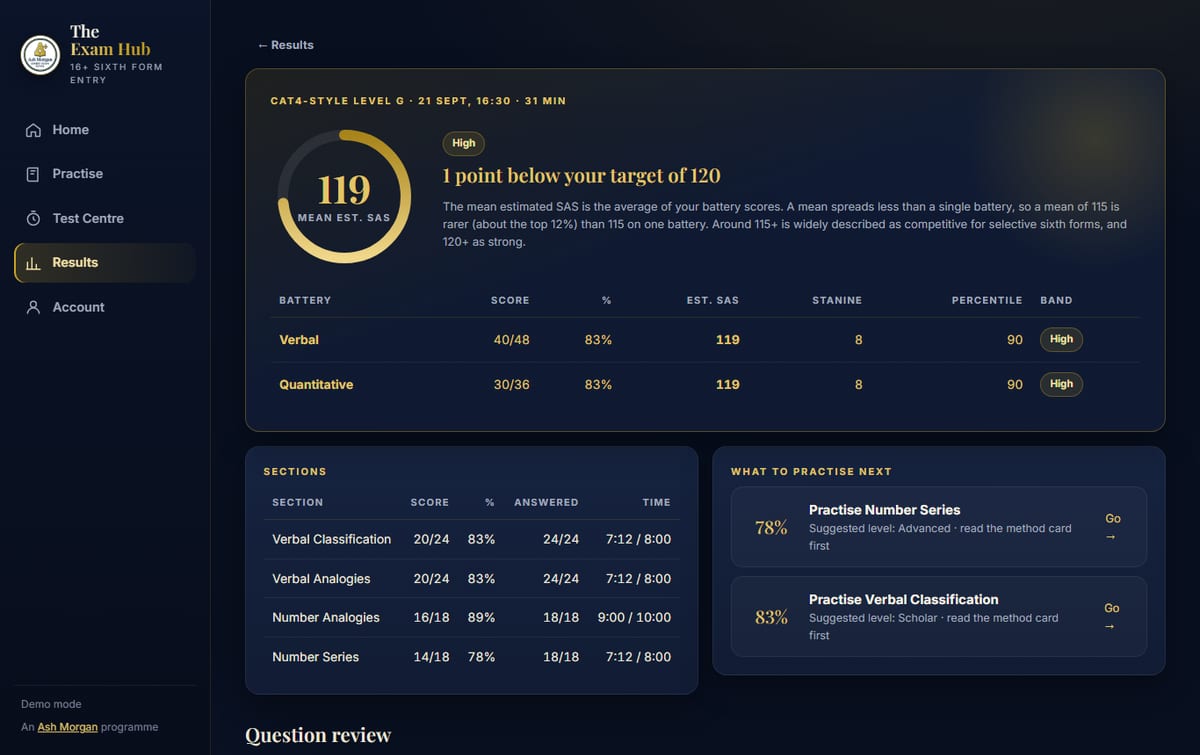
A practice platform built specifically for 16+ entry: CAT4-style reasoning, school-style English and Maths papers, and timed mocks with a full report after every test — estimated standardised scores, a question-by-question review and exactly what to practise next.
The best time to begin is the summer of Year 10, but a focused programme can still make a real difference later on. Get in touch to talk through your child’s schools and timeline.
Make an Enquiry